


 Punjab Board Test Series
 Punjab Boards Notes
 Punjab Board Guess Papers
 Punjab Board Past Papers


FBISE 1st Year Model Papers 2026: Chapter-Wise Weightage Guide

Federal Board · 11th Class · 2026
FBISE 1st Year Model Papers 2026: Which Chapters to Focus On (New 50/50 Pattern)
We analyzed the official FBISE model papers for all five 11th-class science subjects — Physics, Chemistry, Biology, Mathematics and Computer Science — to show exactly where the new 50% MCQ / 50% descriptive paper puts its weight.
Official Model PapersNew 50/50 Pattern5 Subjects AnalyzedChapter Weightage

In this guide:
The Federal Board (FBISE) has changed the paper pattern for 9th and 11th classes: half the paper is now MCQs — including scenario-based questions — and half is short and long descriptive questions. To help you prepare with precision, we went through the official FBISE HSSC-I (1st Year) model papers for all five science subjects and mapped which chapters each section draws from.
An honest note first: this analysis is built only on FBISE’s official model papers and their Tables of Specifications — not on the actual 2026 exam papers (FBISE does not publish those). It shows where the board’s own model puts emphasis, so you know where to focus — while covering the full syllabus.
The New 50/50 Paper Pattern for 11th Class
Here is the exact structure of the official model papers — the same structure your FBISE 11th class papers will follow:
Physics, Chemistry, Biology & Computer Science (80-mark theory papers)
- Section A — 80 MCQs (1 hour 40 minutes): 56 straight MCQs plus 24 scenario-based MCQs built on 6 given situations — each situation followed by 4 questions.
- Section B — 7 short questions: every question carries an internal choice (an OR option of equal difficulty from a different chapter).
- Section C — 2 long questions: every question carries an internal choice, same-chapter parts allowed.
Mathematics (100-mark theory paper)
- Section A — 64 MCQs (1 hour 40 minutes): 40 straight MCQs plus 24 scenario-based MCQs built on 6 given situations.
- Section B — 7 short questions: internal choice in every question.
- Section C — 3 long questions: internal choice in every question (two straight, one with sub-parts).
Four things this pattern tells you about how to prepare:
🎯Scenario MCQs are new
Nearly a third of the MCQs are scenario-based — you read a situation and apply concepts. Rote memorization alone will not crack them.
Nearly a third of the MCQs are scenario-based — you read a situation and apply concepts. Rote memorization alone will not crack them.
🔀Choice in every question
Each short and long question offers an OR from a different chapter — but the two options test different SLOs, so selective study is risky.
Each short and long question offers an OR from a different chapter — but the two options test different SLOs, so selective study is risky.
🧠Understanding wins
About half the paper tests understanding rather than mere recall, per the official Tables of Specifications.
About half the paper tests understanding rather than mere recall, per the official Tables of Specifications.
⏱️Speed is a skill
80 MCQs in 100 minutes means roughly 75 seconds per MCQ — timed practice is non-negotiable.
80 MCQs in 100 minutes means roughly 75 seconds per MCQ — timed practice is non-negotiable.
Physics: Chapter Weightage (Model Paper)
In the official model paper’s Table of Specifications, these are the units the paper leans on most — ordered from heaviest to lightest:
Heaviest focus
WavesHeat and Thermodynamics
Strong presence
ElectromagnetismElectricityFluid MechanicsRotational and Circular Motion
Solid share
Particle PhysicsTranslatory MotionRelativityElectrostatics
Lighter — still examinable
Work and EnergyVectorsMeasurementsPhysics of Solids
Long-question watch: the model paper’s long questions come from Thermodynamics (Carnot cycle), Waves (stationary waves), Electromagnetism (solenoid with iron core) and Rotational Motion (moment of inertia). Short questions span Vectors, Relativity, Projectile Motion, Fluids, Electricity, Magnetism and Particle Physics — including application-style scenarios like a bomb dropped from a plane and a Faraday-cage enclosure.
Chemistry: Chapter Weightage (Model Paper)
Chemistry’s model paper spreads its weight across physical, inorganic and organic chemistry — but one block clearly dominates the descriptive sections:
Heaviest focus — the organic block
HydrocarbonsHalogenoalkanesHydroxy CompoundsCarbonyl CompoundsAmines
Organic chemistry appears in MCQs, short questions (electrophilic addition, IUPAC nomenclature, conversions) and long-question options — it is the single largest chapter block in the paper.
Long-question chapters
Chemical EquilibriumChemical BondingEnergeticsIonic Equilibrium
The model paper’s long questions: Le Chatelier’s principle (Haber and Contact processes), VSEPR shapes and hybridization, the Born–Haber cycle, and solubility product with the common-ion effect.
Short-question & MCQ chapters
StoichiometryAcids, Bases and SaltsChemical KineticsPeriodic TableGroup 17Environmental Chemistry
Atomic Structure
Biology: Chapter Weightage (Model Paper)
Biology’s model paper rewards breadth — fifteen units share the paper, but two stand clearly above the rest:
Heaviest focus
Acellular Life (Viruses)Evolution
Heavy
Animal DiversityMolecular Biology
Strong
Chromosomes and DNACell Biology
Moderate — steady marks
EnzymesBacteriaBioenergeticsInheritancePlant GroupsEcologyReproductionFungi and Protists
Long-question watch: Respiration (electron transport chain), Biological Molecules (polysaccharides), Transcription in prokaryotes and eukaryotes, and Genetics (epistasis with crosses). Note the two scenario-style short questions — an HIV drug blocking reverse transcriptase, and xylem water transport during drought — pure application of concepts, exactly the new pattern’s spirit.
Mathematics: Chapter Weightage (Model Paper)
Mathematics is the only 100-mark theory paper — and its weightage is split between two almost-equal giants:
The two giants (nearly half each)
Numbers and AlgebraGeometry
Smaller share
Information Handling
Long-question watch: Matrices (homogeneous systems), Binomial Theorem, Sequences & Series, Polynomials (factor theorem), Vectors (scalar triple product) and Trigonometric identities. Short questions cover Complex Numbers, Matrices, A.P./H.P., Vectors, Polynomials, Sets, Trigonometry, Probability & Combinatorics, and Functions — including real-life modelling like a Ferris-wheel height problem.
Computer Science: Chapter Weightage (Model Paper)
Computer Science rewards the builders — programming and systems lead, with emerging topics carrying real marks:
Heaviest focus
Programming FundamentalsComputer Systems
Strong
Computational Thinking & AlgorithmsApplications of Computer Science
Moderate
Data and AnalysisDigital LiteracyImpacts of ComputingEntrepreneurship in the Digital Age
Long-question watch: Blockchain (supply-chain scenario) versus Bubble Sort demonstration, and Karnaugh-map simplification versus a Python max/min function. Short questions are heavily scenario-based — SDLC model selection, encryption choices, debugging Python code, trace tables, AI impacts and user testing.
How to Use This Analysis for Maximum Marks
Weightage tells you where to invest — but the new pattern rewards how you study as much as what. Follow this five-step method:
1
Attack heavy chapters first
Attack heavy chapters first
Start with each subject’s heaviest units above — but never fully skip lighter ones: every question’s internal choice can pull its OR option from any chapter.
2
Train scenario MCQs separately
Train scenario MCQs separately
Nearly a third of the MCQs come from just 6 given situations. Practise reading a scenario and applying concepts — not recalling definitions.
3
Drill MCQ speed weekly
Drill MCQ speed weekly
80 MCQs in 100 minutes leaves no room for hesitation. Take timed MCQ sets every week until 75 seconds per question feels comfortable.
4
Write full long answers
Write full long answers
The descriptive half rewards structured, complete answers. Practise the long-question chapters above in full writing — diagrams and steps included.
5
Mock the model paper
Mock the model paper
Attempt an official model paper under timed conditions, then check your weak chapters against this weightage map and re-attack them.
ExamBoost Exclusive
QR Code Answer & Explanation System
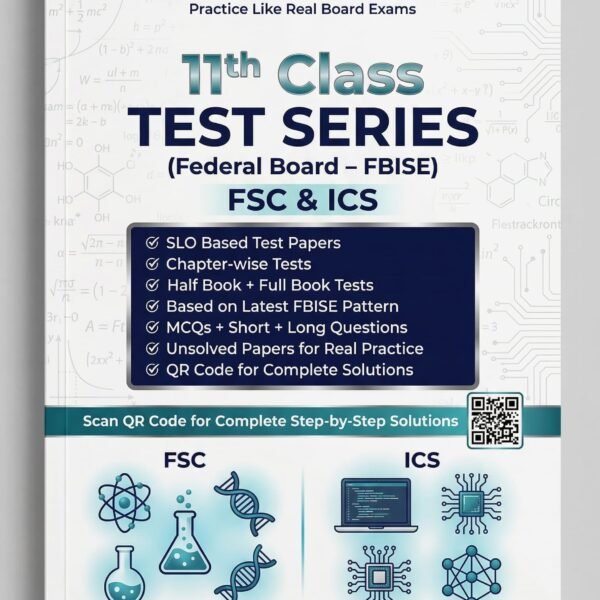
Knowing the weightage is step one — practising it in the exact new pattern is step two. Every ExamBoost test carries a QR code — scan it with your phone and instantly open the complete, detailed QR code solutions for that exact test.
What the solutions include:
- MCQ key with explanation — every MCQ solved, with a clear explanation of why the answer is correct — including scenario-based MCQs.
- Short questions, fully answered — complete model answers written in board format.
- SLO stated with every answer — each question tells you its Student Learning Outcome.
- Long questions, step by step — structured guidance for full-marks answers.
“No stress — the complete solution is just one scan away!”
Practise the New Pattern Before the Board Does
11th Class Federal Board Test Series • SLO-based • 50/50 pattern • QR code solutions • Cash on Delivery
Order Now — View ProductFrequently Asked Questions
Are these the actual FBISE 2026 exam papers?
No. This analysis is built entirely on FBISE’s official model papers and their Tables of Specifications. FBISE does not publish actual annual exam papers, so no one can honestly tell you “which chapters the 2026 paper came from” in advance — but the model papers show exactly where the board itself puts emphasis, which is the most reliable guide available.
Which classes does the new 50/50 pattern apply to?
The 50% MCQ (including scenario-based questions) + 50% descriptive pattern applies to 9th and 11th classes under the new FBISE scheme. The 10th and 12th class pattern remains unchanged from last year.
How many MCQs are there, and how much time do I get?
For Physics, Chemistry, Biology and Computer Science: 80 MCQs (56 straight + 24 scenario-based from 6 given situations) with 1 hour 40 minutes for Section A. For Mathematics: 64 MCQs (40 straight + 24 scenario-based), also 1 hour 40 minutes.
Can I skip the low-weightage chapters?
Not safely. Every short and long question in the model papers carries an internal choice — and the two options come from different chapters and different SLOs. Use the weightage above to decide order and depth, but cover the full syllabus.
Where can I practise the new 50/50 pattern with solutions?
The 11th Class Federal Board Test Series is written on the latest FBISE pattern — scenario-style MCQs, short and long questions with SLOs stated, and a QR code on every test that opens complete step-by-step solutions. Cash on Delivery across Pakistan.
Order Directly From This Article
Like what you see? Get the complete printed 11th class Federal Board test series with Cash on Delivery — select your study group and add it to your cart right here:
1st Year Class Federal Board Test Series
In stock
Price range: ₨ 2,799 through ₨ 4,499
Select options
This product has multiple variants. The options may be chosen on the product page
Start Your FBISE 1st Year Preparation Today
New 50/50 pattern • Scenario MCQs • QR code solutions • All subjects • Cash on Delivery
Get the Test Series Now