


 Punjab Board Test Series
 Punjab Boards Notes
 Punjab Board Guess Papers
 Punjab Board Past Papers


Punjab Board E-Sheet: Complete Guide to the New On-Screen Marking System

Punjab Boards · E-Sheet Guide · 2026–27
Punjab Board E-Sheet: Complete Guide to the New On-Screen Marking System
What the E-sheet is, which exams and subjects are confirmed, how to fill it step by step — and an honest look at whether the new system is actually better for students.
BISE Lahore Notification 5124 Initial Subjects2nd Annual 2026 PilotAll 9 Boards
In this guide:
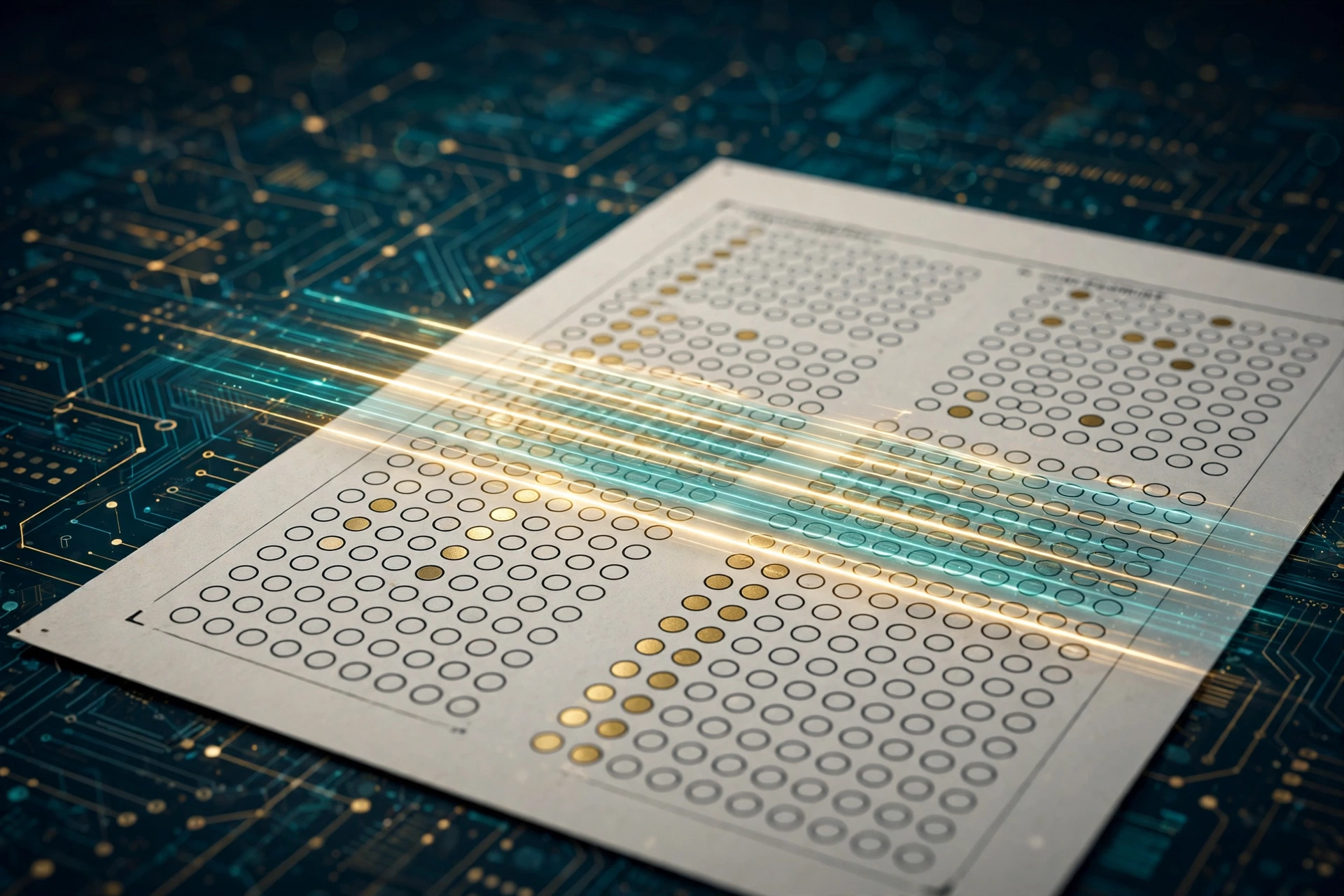
Punjab’s board examinations are changing. The Punjab board E-sheet — the new scan-friendly answer sheet behind the On-Screen Marking (OSM) system — is the biggest shift in how BISE papers are written and checked in decades. Students are confused, teachers are still being trained, and social media is full of half-true claims. This guide separates official fact from hype: what the boards have actually announced, what the E-sheet looks like, exactly how to fill it, and an honest answer to the question every student is asking — is this system actually better for me?
Official Status: What Is Confirmed vs What Is Expected
Before anything else, here is the honest picture. A lot is being shared online as “official” that the boards never actually said:
✅ Officially Confirmed
- BISE Lahore is moving to On-Screen Marking. Letter No. 512-RCO/BISE LHR, dated 7 October 2026, officially announces the board is moving towards OSM “this year.”
- Four initial subjects, Intermediate level: Chemistry, Biology, Computer Science and Statistics.
- Mandatory training is underway: district-wise workshops for examiners, principals, heads of department and students ran from 12 to 31 October 2026 across Lahore, Kasur, Sheikhupura and Nankana Sahib.
- Provincial pilot in supplementary exams: the Punjab Education Minister directed all boards to introduce digital marking starting on a pilot basis in supplementary examinations.
- BISE Rawalpindi confirmed its rollout on 28 October 2026 through an official press release, after mock drills with education officers, principals and exam controllers.
⚠️ Widely Reported / Expected (Not Directly Quoted in the Notification)
- 2nd Annual 2026 as the pilot exam. The 7 October letter does not name which exam comes first — but the next intermediate exam is the 2nd Annual starting 3 November 2026, the minister ordered a supplementary-exam pilot, and BISE Lahore’s chairman announced OSM from the second annual examinations. All signs point here.
- Other Punjab boards following. Beyond Lahore and Rawalpindi, the remaining boards are reported to be preparing under the provincial plan — each board will issue its own circular. Check your own board’s website before your paper.
- First Annual 2027: all subjects on E-sheets? This is not officially confirmed. The notification covers four intermediate subjects; wider rollout is expected in phases, not announced.
The rule for this entire guide: anything the boards have announced is stated as fact; anything merely circulating online is labelled expected or reported. If your roll number slip or your board’s latest circular says something different on exam day, the board’s paper always wins.
What Is the E-Sheet? (Mukammal Taaruf)
The E-sheet (electronic answer sheet) is the new board answer copy designed for On-Screen Marking (OSM) — Punjab’s digital evaluation system. Let’s clear the biggest confusion first:
An E-sheet exam is NOT an online exam. You still go to the examination centre, sit on the same bench, and write with a pen on paper. What changes is what happens after you hand in your copy: instead of travelling in bundles to marking centres, your answer sheet is scanned with high-speed scanners and examiners check the digital image on their computer screens through the board’s secure system.
Think of it in two halves — your half stays physical, the checking half goes digital:
| Stage | Traditional System | E-Sheet / OSM System |
|---|---|---|
| You write | On a plain answer booklet, free-flowing pages | On a structured E-sheet: bubbles for MCQs and ID, fixed boxes for each descriptive answer |
| After the exam | Bundles travel physically to marking centres | Sheets are scanned immediately; digital copies go to a secure central server |
| Who checks | One examiner gets your whole script | Each question can go to a different examiner — human teachers still assign every mark |
| MCQs | Checked manually by the examiner | Read automatically by the scanner from your filled bubbles |
| Total | Added by hand (totalling mistakes happen) | Calculated automatically by the system |
| Examiner identity | Paper-based trust | Secure login with face verification before marking |
| Record | Physical copy filed away | Complete digital record of every question — easier rechecking |
Two myths need to die right here. Myth 1: “a computer will check my answers.” No — human examiners still read and mark every descriptive answer; the computer only displays the scanned sheet, reads MCQ bubbles, and adds up the total. Myth 2: “the paper pattern changed.” The E-sheet changes the answer copy and the checking method, not the syllabus, the pairing scheme or the marks distribution.
Inside the E-Sheet: Every Section Explained
The E-sheet looks different from the old answer copy because every part of it has a job in the scanning process. Based on detailed guides to the new sheet design, here is what you will see — always follow the printed instructions on your own sheet on exam day, since the board’s paper is final:
📄 The Front Sheet — Five Parts
1
Computer section (top)
Computer section (top)
QR codes, barcode and page number. This is how the scanner identifies your copy. Do not write anything here.
2
Class / part / session bubbles
Class / part / session bubbles
Fill exactly one bubble per row: Matric or Inter, Part 1 or Part 2, Annual or 2nd Annual, Morning or Evening.
3
Roll number & paper code
Roll number & paper code
Write your roll number digits in the boxes, then darken the matching bubbles below. Do the paper code the same way — match both against your roll number slip. A wrong paper code can attach your copy to the wrong subject.
4
Identification details
Identification details
Your personal details area — fill it exactly as on your slip.
5
Date, name & signature
Date, name & signature
Fill day, month and year boxes, write your name and father’s name, and sign clearly. Leave the Deputy Superintendent’s signature space blank — it is not for students.
📝 The Inside Pages — Boxed Answers
This is the biggest writing change. The inside pages are also designed for scanning: every sub-question gets its own separate box, and your complete answer to that sub-question must stay inside its box:
- Definitions, formulas, units and examples — all inside the given box.
- Chemistry: write chemical equations within the box — no sprawling across the page.
- Biology: draw diagrams with clear labels inside the box; keep labels legible at scan resolution.
- Steps on separate lines: for numericals, write each step on its own line and make the final answer unmistakable.
- Never cross the border: anything outside the box lines may not be visible to the teacher checking on screen.
🔵 The MCQ Bubble Sheet
MCQs are no longer checked by a teacher at all — the scanner reads your bubbles. That makes bubble discipline non-negotiable:
- One bubble per question — filling two bubbles for one MCQ marks it wrong.
- Fill completely and dark — a cross mark, tick mark or half-filled bubble is not counted.
- Match question numbers — when you move to the next column, check the question number against the bubble column. One slipped row can misalign everything after it.
- Blue or black ballpoint only — never a red pen or a pencil on the board copy.
Which Exams & Subjects Are Confirmed
Here are the facts and figures, each tied to its source:
| Fact | Detail | Status |
|---|---|---|
| Official notification | BISE Lahore letter No. 512-RCO/BISE LHR, dated 7 Oct 2026 — moving towards On-Screen Marking “this year” | ✅ Confirmed |
| Initial subjects | Chemistry, Biology, Computer Science, Statistics — Intermediate level only | ✅ Confirmed |
| Training | Mandatory workshops 12–31 Oct 2026 (Lahore, Kasur, Sheikhupura, Nankana Sahib) for examiners, principals, HoDs and students | ✅ Confirmed |
| 2nd Annual 2026 as pilot | Part-II: 3–16 Nov 2026; Part-I: 17–28 Nov 2026. Minister directed a supplementary-exam pilot; BISE Lahore chairman announced OSM from second annual exams | ⚠️ Strongly expected |
| BISE Rawalpindi | Digital marking rollout confirmed 28 Oct 2026 via official press release (Chairman Prof. Dr. Iqbal Mahmood); mock drills completed; examiner training begun | ✅ Confirmed |
| Other 7 boards | Reported to be preparing under the provincial plan; each board issues its own circular | ⚠️ Reported |
| Matric E-sheets | News reports say BISE Lahore finalised preparations for Matric Computer Science; the official 512 notification covers Intermediate only | ⚠️ Reported, not in notification |
| First Annual 2027, all subjects | No official announcement found; expansion is expected in phases | ❌ Not confirmed |
For 11th and 12th class students: the four confirmed subjects — Chemistry, Biology, Computer Science, Statistics — are exactly the papers where this matters most right now. If you are appearing in the 2nd Annual exams starting 3 November 2026, prepare as if your paper will be on the E-sheet: the boards’ own training finished days before the exams.
How to Attempt the E-Sheet: Step-by-Step Method
The E-sheet rewards a different exam technique than the old copy. Follow this method in order — it is built around how the sheet is actually scanned and checked:
1
Read the printed instructions first
Read the printed instructions first
Every E-sheet carries printed instructions. Spend the first two minutes reading them — sheet designs can vary slightly by board, and the printed sheet overrules everything you read online.
2
Fill the front sheet slowly
Fill the front sheet slowly
Bubbles for class, part and session — one per row. Roll number digits in boxes, then darken the matching bubbles. Paper code the same way. Cross-check both against your roll number slip twice. Most E-sheet disasters happen here, before a single question is answered.
3
Attempt MCQs with bubble discipline
Attempt MCQs with bubble discipline
Solve on the question paper first, then fill. One bubble per question, filled completely and dark, blue or black ballpoint. After every 5 MCQs, glance back to confirm the question number still matches the bubble row.
4
Write descriptive answers inside their boxes
Write descriptive answers inside their boxes
Find the box for the exact sub-question number before you start writing. Plan compact answers: definition first, then explanation, then example — all within the borders. If an answer feels too long for its box, tighten it; do not spill over.
5
Number everything, match everything
Number everything, match everything
Because each question may go to a different examiner, an answer in the wrong box can mean the right teacher never sees it. Write the question number at the start of every answer and double-check it against the box label.
6
Keep it scan-clean
Keep it scan-clean
Clear, dark handwriting — faint writing scans faintly. No overwriting into blobs, no ink smudges, no folded corners. Do not fold, staple or add pages to the copy.
⏱️ Time Management on the E-Sheet
- Front sheet: 5 minutes, no rushing. Treat it as part of the paper — a wrong roll number or paper code can invalidate everything after it.
- MCQs: steady pace, verify in batches. Fill bubbles as you go rather than all at the end — end-of-paper rushing is where misaligned rows happen.
- Descriptive: budget per box. Before writing, decide roughly how many minutes each question’s box deserves based on its marks. Boxed answers punish rambling — plan, then write.
- Last 10 minutes: verification round. Re-check bubble rows against question numbers, confirm every attempted question sits in its correct box, and make sure no box you attempted is left half-empty by mistake.
Mistakes That Cost Marks on the E-Sheet
Under the old system, a kind examiner might hunt through your copy for a misplaced answer. Under OSM, the scanner and the question-wise routing do not hunt. Avoid these:
- Writing on the QR/barcode section — the top computer section identifies your copy. Any writing there risks a scanning failure.
- Two bubbles for one MCQ — the scanner marks it wrong. There is no “the examiner will understand” anymore.
- Half-filled or tick-marked bubbles — not counted. Fill every bubble completely and dark.
- Answer in the wrong box — with each question routed to a different examiner, a misplaced answer may never be seen at all.
- Writing outside box borders — anything crossing the border may be cut off on the examiner’s screen.
- Wrong roll number or paper code — your copy can be matched to the wrong subject entirely.
- Red pen or pencil anywhere — use blue or black ballpoint only.
- Folding, stapling or adding pages — the sheet must feed cleanly through high-speed scanners.
- Identification marks — pins, signs or symbols on the copy are prohibited.
Is the E-Sheet System Actually Better? An Honest Analysis
Students keep asking whether the E-sheet helps or hurts them. Here is the straight answer — both sides, nothing hidden:
✅ Where the E-Sheet System Is Genuinely Better
- No more totalling mistakes. The computer adds up your marks, so the classic “my marks were added wrong” complaint disappears.
- Fairer checking per question. With each question going to a different examiner, one strict or lenient teacher can no longer decide your whole paper — single-examiner bias is diluted.
- Examiners are verified. Face verification and secure logins mean the appointed teacher actually checks your paper — not someone they handed their bundle to.
- Transparency and monitoring. Boards can see who checked which question and when, with time limits for examiners — the process is watched in a way physical bundles never were.
- Better rechecking. A complete digital record of every question makes rechecking requests easier to review fairly.
- Faster results (in principle). Marking can start sooner and run in parallel across examiners, which should shorten result timelines.
⚠️ Honest Concerns Students Should Know
- Nobody has practised on it. This is the biggest real problem: students have spent years writing free-flowing answers, and teachers themselves are still in training — the workshops only ran 12–31 October, days before the 2nd Annual exams. A new answer format with zero past papers to practise on is genuinely stressful.
- Boxed answers punish long writers. If you naturally write detailed answers, fitting them into fixed boxes is a new skill — and anything outside the border may simply not be seen.
- The scanner is unforgiving. A human examiner might overlook a half-filled bubble or a smudge; the scanner will not. Small filling mistakes that once cost nothing can now cost the whole MCQ.
- Wrong-box answers can vanish. Question-wise routing is fairer, but it means a misplaced answer — which a single examiner would once have found — might never reach the right teacher.
- Technical risk is real. Scanning errors, faint handwriting picked up poorly, QR misreads — any large new system has teething problems, and the pilot exams are where they surface.
- Unanswered official questions. As of now there is no published official word on rough-work policy or wrong-bubble correction procedure — students are being asked to adapt before all the rules are public.
The bottom line: the E-sheet system is better for the system — fairer, more transparent, fewer mechanical errors. For the student, it is better only if you adapt your technique: bubble discipline, boxed answers, correct numbering. The students who practise the new format before exam day keep all the upside; the ones who walk in cold carry all the risk. That is exactly what the preparation section below is for.
Prepare for the E-Sheet Era: Practice in Board Format
Here is the practical truth: the E-sheet does not change what you must learn — Chemistry still needs balanced equations in tight boxes, Biology still needs labelled diagrams that scan clearly, and MCQs still reward speed and accuracy. What wins now is practising in the actual board format: timed tests, MCQs with bubble-style discipline, short and long questions written compactly and completely.
That is what the ExamBoost Punjab board test series are built for — SLO-based, chapter-wise, half-book and full-book tests with QR code solutions for every test, so you can check every answer the same day:
📘9th Class
Build the foundation early — practise MCQs and boxed answers from day one with the 9th Class Punjab Board Test Series.
Build the foundation early — practise MCQs and boxed answers from day one with the 9th Class Punjab Board Test Series.
📗10th Class
Matric board exam practice in the new checking reality with the 10th Class Punjab Board Test Series.
Matric board exam practice in the new checking reality with the 10th Class Punjab Board Test Series.
📙11th Class (1st Year)
Intermediate concepts, pairing-scheme aligned — the 11th Class Punjab Board Test Series.
Intermediate concepts, pairing-scheme aligned — the 11th Class Punjab Board Test Series.
📕12th Class (2nd Year)
Urgent for 2nd Annual candidates — full-pattern rehearsal with the 12th Class Punjab Board Test Series.
Urgent for 2nd Annual candidates — full-pattern rehearsal with the 12th Class Punjab Board Test Series.

10th Class Punjab Boards Test Series New Course
In stock
Price range: ₨ 2,150 through ₨ 2,600
Select options
This product has multiple variants. The options may be chosen on the product page
11th Class Punjab Boards Test Series
In stock
Price range: ₨ 2,050 through ₨ 2,600
Select options
This product has multiple variants. The options may be chosen on the product page
| Select Study Group Intermediate | FA Arts (All Subjects Included), FSC & ICS Both (All Subjects Included), FSC Medical (All Subjects Included), FSC Pre-Engineering (All Subjects Included), I.com (All Subjects Included), ICS with Economics (All Subjects Included), ICS with Physics (All Subjects Included), ICS with Statistics (All Subjects Included) |
|---|
12th Class Punjab Boards Test Series New Course
In stock
Price range: ₨ 2,150 through ₨ 2,700
Select options
This product has multiple variants. The options may be chosen on the product page

9th Class Punjab Boards Test Series
In stock
Price range: ₨ 2,150 through ₨ 2,600
Select options
This product has multiple variants. The options may be chosen on the product page
Pair it with our 11th class Punjab board test series for complete preparation.
2nd Annual Exams Start 3 November — Practise in E-Sheet Format Now
Chapter-wise tests • MCQ + short + long in board format • QR code solutions • Cash on Delivery across Pakistan
Get the 12th Class Punjab Test SeriesPair it with our 12th class test series for complete preparation.
Frequently Asked Questions
What is the E-sheet in Punjab board exams?
The E-sheet is the new scan-friendly answer sheet for Punjab’s On-Screen Marking (OSM) system. You still write with a pen on paper at the exam centre, but your sheet is then scanned and examiners check the digital image on their computers. MCQs are read automatically by the scanner, totals are calculated automatically, and each descriptive question can go to a different human examiner.
Is the E-sheet confirmed for the 2nd Annual 2026 exams starting 3 November?
It is strongly expected but not directly quoted in the official notification. BISE Lahore’s letter (No. 512, dated 7 Oct 2026) says the board is moving towards on-screen marking “this year” without naming the exam; the Education Minister directed a pilot in supplementary exams, and BISE Lahore’s chairman announced OSM from the second annual examinations. Since the 2nd Annual (Part-II: 3–16 Nov, Part-I: 17–28 Nov 2026) is the next exam, all signs point to it — prepare as if your paper will be on the E-sheet.
Which subjects will use E-sheets first?
Per BISE Lahore’s official notification, the four initial subjects are Chemistry, Biology, Computer Science and Statistics — all at Intermediate level. Wider rollout to more subjects is expected in phases but has not been officially announced.
Does the E-sheet apply to all Punjab boards or only Lahore?
The reform is provincial: the Education Minister directed all boards, BISE Lahore issued the first official notification, and BISE Rawalpindi confirmed its own digital marking rollout on 28 October 2026 via official press release. The remaining boards are reported to be preparing under the same plan. Check your own board’s website/circular for its specific announcement.
Will a computer check my paper?
Only the MCQ bubbles are read by the scanner and the total is calculated automatically. Every descriptive answer is still read and marked by a human examiner — they just see your scanned sheet on a screen instead of holding the physical copy.
Which pen should I use on the E-sheet?
According to detailed guides on the new sheet: a blue or black ballpoint pen, filling bubbles completely and dark. Do not use gel pens or pencils, and never a red pen. Always follow the printed instructions on your own sheet — the board’s paper is final.
What happens if I fill the wrong bubble for an MCQ?
The scanner reads what is filled — filling two bubbles for one question marks it wrong, and a half-filled bubble may not be counted at all. No official correction or replacement-sheet procedure has been published, so official clarification is still awaited. The safe rule: solve on the question paper first, fill carefully, and verify question numbers in batches of five.
Is rough work allowed on the E-sheet?
Official clarification is still awaited — the boards have not published a rough-work policy for the new sheet. Do not assume extra pages will be provided or accepted, since the guides prohibit adding pages to the copy. Use the question paper margins for rough calculations where permitted, and watch for your board’s instructions.
What if my answer goes outside the designated box?
Keep every answer strictly inside its box. Anything crossing the border may be cut off on the examiner’s screen — and because each question can go to a different examiner, an answer written in the wrong box may never be seen. Plan compact answers: definition, explanation, example — in that order.
Will all First Annual 2027 exams be on E-sheets?
Not officially confirmed. The notification covers four intermediate subjects, with wider rollout expected in phases. News reports mention preparations for Matric Computer Science as well, but no board has announced “all subjects, all classes” for 2027. Treat it as expected, not promised — and keep checking your board’s official circulars.
Punjab board 9th class paper kab honge 2027?
2027 papers ki date sheet abhi officially announce nahi hui. Date sheet se pehle E-sheet format ki practice mukammal kar lein taake naye on-screen marking system mein koi surprise na ho.
Final Words
The Punjab board E-sheet is not a trick and not a reason to panic — it is a new answer format with clear, learnable rules. The students who will gain from it are the ones who practise the format before exam day: one bubble per MCQ, filled dark; every answer inside its box; every question number matched; clear, scan-friendly handwriting. The system itself is fairer — automatic totals, verified examiners, question-wise checking — but fairness only helps the prepared.
With the 2nd Annual exams starting 3 November 2026, the time to adapt is now: attempt full-pattern tests under timed conditions, write compact boxed answers, and check every solution the same day with QR code solutions. For delivery details see our Delivery & Return Policy.
Read our complete 11th class test series guide to plan your preparation.
Start Your E-Sheet Practice Today
9th, 10th, 11th & 12th Punjab Board Test Series • Board-format tests • QR code solutions • Cash on Delivery
Order the Test Series Now